Places 2 Visit

Showing posts with label slavery. Show all posts

Sunday, December 15, 2019

They Were Her Property...My Thoughts #ADOS


What I found sinister as well as ingenious was how white wealth was held in the families. The female would get the slaves and the sons would get the land, that way when they moved on and married other people it was a match made in heaven, she had the slaves to work the land she just married into.
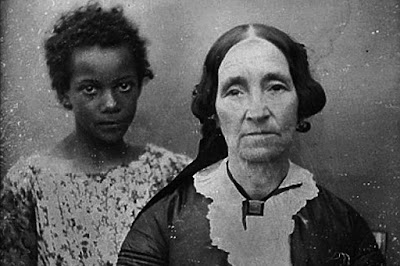
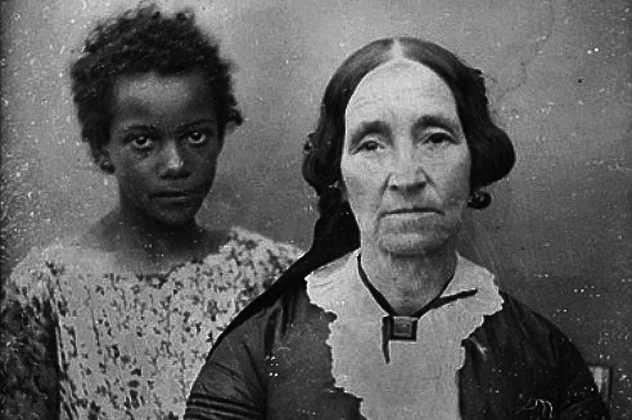
White women were very much a part of slavery and all its dealings. However; we have been programmed to believe that white women were innocent  when it came to slavery and that they were not aware of “men folks business.”
On the contrary, many were being groomed into being successful slave mistresses, just as their counter-parts.


From the book: They Were Her Property: White Women who were Slave Owners in the American South, many slaves were giving to white women as wedding gifts…one slave recalls that one of his owners gave his daughter “50 niggers as a gift…”
I find it interesting that early on during slavery… black women were discourage in having children; because it took away from their “white women bearing children…”, but in 1808 when slavery became illegal from Africa. That law drastically effect white folks income…therefore the prize was child-bearing enslaved females, so they could now breed and begin to record those unions and off-springs…


Slave owning females are recorded forcing their female slaves to have sex with different black men…it did not matter whether that black female was “married.”
One of the many stories of white slave owning women was that how one- started with 30 slaves; however within 10 years she had over 100 all she created mixing and matching black men or any other ((white)) man that paid “the right price” impregnating her “good-nigger gals…”  One slave recalls hearing his white slave owner saying “she wouldn’t depart from her favorite breeding nigger girl for no amount of money!…”

                    Because white women had loss their legal rights to their goods…if there was not a legal letter stating that their property was solely theirs before they got married. When I women got married she was called a “feme covert” or married woman. Many white women fathers would leave wills stating that they gave slaves to their daughters to use at their own well and not to be included with their husbands property…that way this legal paper protected their daughters property from her (future) husband(s) misfortunes… because many white men did lose a lot of their belongs and the creditors would sometimes try and take their wives property for payment.
Even though white woman had some restrictions, they at least had the opportunity to have their voices be heard thru the courts, without fear of being killed, raped or their husbands being mutilated for speaking up.
                   
         It was also believed that enslaved peoples didn’t understand what was going on around them, this is a myth: according to the recordings left by freed and former slaves “they were very aware…” what their owners** were doing; considering it was them that was being sold. Many enslaved people also knew what would happen if their owners died with NO will(s) and the risk of being sold to someone else.

                    White women were often at odds with their mates, even though they had some say when their husbands fucked up, they also wanted some form of protection (law) and would often fight for it. Also, white women did not like their husbands very much, and I feel that most white women got married because of their religious beliefs, but more so for social status. And they reproduced with these men only because they both were on the same understood, that nothing was in their way in creating wealth and a legacy.

Yet black people did not have this luxury. We were shipped here together; as a collective, as one unit. We are in this fight together, there is no individual success story, even with white families today; as well as the past, and there was not just one individual that was successful. It was a network, a joint effort to make sure that the wealth stayed in the family…and they made sure that every slave they owned-that those descendants of those slaves-they owned as well.


My thoughts and understanding on the Book: They Were Her Property
A  ADOS book club selection.

**slaves did not refer to their owners as “master”

Sunday, February 19, 2012

Black History My History 4


Slave Grown Cotton in a Global Economy: Mississippi (1800-1860)

Mississippi History Now published an article in 2006 entitled, "Cotton in a Global Economy: Mississippi (1800-1860)," by Eugene R. Dattel that states, "William Faulkner, Mississippi’s most famous novelist, once said, “To understand the world, you have to understand a place like Mississippi.”


To the world, Mississippi was the epicenter of the cotton production phenomenon during the first half of the 19th century. The state was swept along by the global economic force created by its cotton production, the demand by cotton textile manufacturing in Europe, and New York’s financial and commercial dealings. Mississippi did not exist in a vacuum. So, in a sense, Faulkner’s words could be reversed: “To understand Mississippi, you have to understand the world.”

Mississippi’s social and economic histories in early statehood were driven by cotton and slave labor, and the two became intertwined in America. Cotton was a labor-intensive business, and the large number of workers required to grow and harvest cotton came from slave labor until the end of the American Civil War. Cotton was dependent on slavery and slavery was, to a large extent, dependent on cotton. After emancipation, African Americans were still identified with cotton production.
This particular chapter of the story of slavery in the United States starts at the Constitutional Convention of 1787 in Philadelphia, Pennsylvania. When the delegates wrote and agreed upon the Constitution, cotton production was virtually nonexistent in America. There were approximately 700,000 slaves in the United States at the time of the signing of the Constitution. The slave states of South Carolina and Georgia were adamant about having slavery protected by the Constitution. Connecticut’s Roger Sherman, one of the delegates who brokered the slavery compromise, assumed that the evil of slavery was “dying out … and would by degrees disappear.” He also thought that it was best to let the individual states decide about the legality of slavery. Thus, the delegates faced the question: should there be a United States with slavery, or no United States without slavery? The delegates chose a union with slavery.


Soon after the signing of the Constitution, cotton unexpectedly intervened in the 1790s and changed the course of America’s economic and racial future because of the simultaneous occurrence of two events: the mass production of textiles and the mass production of cotton. In the late 18th century, the process started in Great Britain where several inventions — the spinning jenny, Crompton’s spinning mule, and Cartwright’s power loom — revolutionized the textile industry. The improvements allowed cotton fabrics to be mass produced and, therefore, affordable to millions of people.


At the same time, Eli Whitney, a twenty-eight-year-old unemployed recent graduate of Yale University, journeyed to the South to become a tutor on a plantation. He soon became obsessed with the bottleneck in cotton production on his employer’s Georgia plantation. In 1793, the fledgling mechanic soon found a solution to the problem of cleaning cotton and the separation of the seed from the fiber. After a few months, he wrote the now-famous letter to his father in which he described his discovery: “I involuntarily happened to be thinking on the subject [of cleaning cotton] and struck out a plan of a Machine [to remove the cotton seed]…I concluded to relinquish my school and turn my attention to perfecting the Machine.” That machine was the cotton gin.


Whitney gave up his career as a teacher to devote full time to manufacturing cotton gins and making money. Sadly for Whitney, the cotton gin generated no profits because other manufacturers copied his design without paying him fees. He had obtained a patent on the cotton gin but it proved to be unenforceable. Whitney’s priorities, henceforth, were money and manufacturing. Whitney never seemed, as one historian noted, to care about slavery “one way or the other.”
Whitney is given credit for unleashing the explosion of American cotton production which was, in turn, propelled by the seemingly insatiable appetite for cotton from the British cotton textile mills. A quick glance at the numbers shows what happened. American cotton production soared from 156,000 bales in 1800 to more than 4,000,000 bales in 1860 (a bale is a compressed bundle of cotton weighing between 400 and 500 pounds). This astonishing increase in supply did not cause a long-term decrease in the price of cotton. The cotton boom, however, was the main cause of the increased demand for slaves – the number of slaves in America grew from 700,000 in 1790 to 4,000,000 in 1860. A materialistic America was well aware of the fact that the price of a slave generally correlated to the price of cotton. Thus, the cotton economy controlled the destiny of African slaves.


Eugene R. Dattel,
 a Mississippi native and economic historian, is a former international investment banker. His first book, The Sun That Never Rose, predicted Japan's economic stagnation in the 1990s. His next book, Cotton and Race in America (1787-1930): The Human Price of Economic Growth, will be published in 2007. (Posted October 2006 in the Mississippi Now).


Quotes

Show me someone who never makes a mistake and I'll show you someone who never does anything.