Places 2 Visit

Showing posts with label African American History. Show all posts

Sunday, September 15, 2013

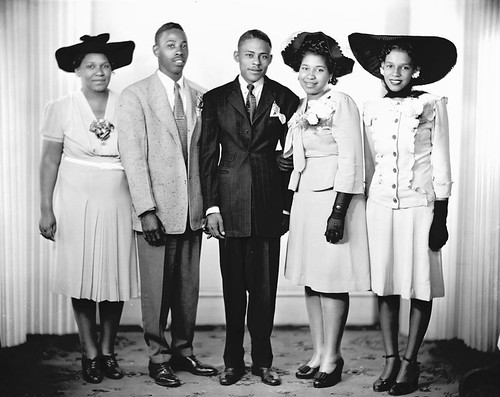
Black History Vintage Photos ((All In The Family, 1940))

I love vintage photos of black folks.
In the early 1900's females dressed classy and elegant.


Via Flickr:
Photograph by Addison N. Scurlock. National Museum of American History, Smithsonian Institute.

Vintage African American photography courtesy of Black History Album, The Way We Were.

Follow Us On Twitter @blackhistoryalb

Monday, February 20, 2012

Black History My History (Edward Roye)


Liberia's Fifth President, President Edward Jenkins Roye. Edward Roye was born into a prosperous family in Newark, Ohio. He immigrated to Liberia in 1846 and set up business as a merchant. In 1849, Roye became active in Liberian politics, rising to the position of President of the Republic in 1870. Roye took office in the midst of a fiscal crisis and was ultimately ousted by his opponents in 1871.
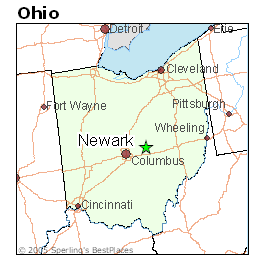


More than 160 years ago, two members of the board of trustees of the town of Newark, Ohio met and issued an order that all Negroes should leave within twenty-four hours. A constable was sent out to the black community to inform them of the order of banishment. A young black boy ran to the home of the third member of the board of trustees, A.E. Elliot, begging him to use his influence to circumvent the order. Elliot, his son, and Eddie Roye, went along to the Square where a large crowd had gathered, both blacks and whites. The entire Negro population was pleading that they should not be driven from their homes. Elliot did use his influence; he protested that such hasty action would create hardship on the people involved. His arguments proved effective and the order was postponed until it could be given more consideration. The postponement became indefinite and was never brought up again.
Trustee Elliot went about his affairs as usual, but young Eddie Roye must have walked away from the Square with a determination to find a land with freedom for "men of color."


The history of Edwards J. Roye and the history of Newark begin at about the same time. In 1810, just eight years after Newark was founded and surveyed, John Roye is recorded as having purchased a lot on the south side of the Square. Roye, said to have been born in slavery in Kentucky, came north with his wife Nancy and became a prosperous land owner. Their son, Edward J. Roye was born in a little house on what is now Mount Vernon Road on Feb. 3, 1815. He was educated in Newark schools, but nothing much is known of his early years. In 1822, his father sold his Newark property and went to Illinois, leaving Edward and his mother behind. A letter dated April 14, 1829, from John Edward Roye, is in the Vandalia Illinois courthouse. The letter beginning, "Dear Son," leaves all the property John Roye had acquired in Illinois to his son Edward.


Several biographers say Edward Roye became a barber, which was acceptable occupation for a black at that time. Newark did not have a white barber until 1856. By the year 1832, Edward Roye had left his hometown and was enrolled in Ohio University in Athens. He went on to teach school at Chillicothe in 1836 and after that he moved to Terre Haute, Ind., where he opened that city's first bathhouse/barbershop next door to the best hotel.

By the time Nancy Roye died and was buried in the Sixth Street cemetery in 1840, the mood of the country was changing. Colonizationists wanted to remove all blacks and send them to Africa. Whether due to changing in climate of the 1840's or to the scene around the Square that day in his childhood, Edward Roye decided to leave the United States for an African country, Liberia. On May 1, 1846, Roye sailed from New York and one month later landed in Monrovia.


His energy and intelligence soon made him a leading merchant and after acquiring great wealth, he returned to the U.S. on his own ship. It is said he visited Newark where he was entertained at a banquet for an event for Thomas Ewin, adoptive father of William Tecumseh Sherman.

Years later Roye became chief justice, speaker of the House, and finally, president of Liberia in 1871. He began a program of reconstruction for his nation intending to build new roads and schools.


For these purposes he needed money. Roye sailed for England where he began negotiations with London banks. The results proved ruinous, the terms of the loans were severe, among other things carrying an interest of 7 percent. Roye hastily agreed without consulting the legislature. Liberia actually received about $90,000, while bonds were issued for $400,000.


The whole affair caused great resentment against him, and when he returned home he was accused of embezzlement. He then tried to extend his two-year term of president by edict, after the people rose up against him.
In October 1871, Edward J. Roye was deposed from office., He was brought to trial, but escaped in the night . His is believed to have drowned while trying to reach a English ship in Monrovia harbor, on Feb. 12, 1872.

After many years the nation of Liberia has taken another look at their fifth president. A building housing what was the True Wig Party headquarters is named in his honor, as well as a ship, a town, and several schools.


The Ohio Historical Society refers to 
Edward James Roye as the "Ninth and Forgotten President from Ohio." 
While in a land far away from the 
"land of Legend" 
he is known by some as the "Lincoln of Liberia." 


More Info

Sunday, February 19, 2012

Black History My History 3


From Black Banjo Gathering this article "About the Banjo," written by Tony Thomas discusses the banjo and American folk music. Tony Tomas writes: 
The banjo is a product of Africa. Africans transported to the Caribbean and Latin America were reported playing banjos in the 17th and 18th centuries, before any banjo was reported in the Americas. Africans in the US were the predominant players of this instrument until the 1840s. Originally the banjos were made out of gourds and skins. The strings numbered between three and nine, with four- and five-string banjos being popular. A distinguishing feature was one or more short drone strings sounded with the thumb.


Banjo playing became an object of popular white culture in the US and later in Britain as a result of the Blackface Minstrel shows that became a popular form of entertainment in the 1830s and 1840s. Minstrels from the South who had actually learned real African-American music like Joel Sweeney popularized the banjo by introducing the claw hammer or frailing style that Blacks had brought from Africa. Commercial banjo makers later claimed that Sweeney invented the banjo in order to cover up its African origin. Sweeney did work with luthiers and drum makers to help perfect drum head banjos, the most common type, and is thought to have popularized the five-string banjo as opposed to the four-string banjo. Banjo playing became widely popular among working class and poor people both urban and rural. While African Americans continued their tradition with the instrument, whites also became fans, makers and manufacturers of the banjo.


Banjos began to be built by fine instrument makers, factory scaled manufacturers, as well as working people and farmers who worked with home-made materials. Gradually, the sturdier drum head style of banjo began to replace the gourd banjos...


Banjo playing expanded in the late 19th Century when classic banjo playing finger-picking styles made the banjo a popular instrument among the upper classes and social elites of the US and Britain. While efforts were made to distance the banjo from its African origins and its continued popularity as the instrument of the poor and the Black, nevertheless the outstanding player of period was Horace Weston, an African-American who excelled at the classic, minstrel, and traditional African-American banjo styles.

In the last 30 years of the 19th Century, manufacturers added frets to banjos to make them easier to play for beginners; these became a standard part for most manufactured banjos while people continued to make their own fretless and gourd banjos. In the same years banjo-based instruments aimed at taking the place of various orchestra instruments such as the banjo cello, banjo-bass, mandolin banjo, and banjo mandolin flourished as banjo orchestras became popular particularly among college students.

The twentieth century saw the emergence of steel strings on the banjos. This meant banjos could be played with a plectrum or pick. This led to the plectrum banjo and the more popular tenor banjo, which were both four-string banjos with the fifth drone string removed. These instruments proved popular for pop, dance, tango, and Jazz bands until they started to be replaced by the guitar in the late 1920s and 1930s.


While five-string banjo playing retained a support among African-Americans and whites in the Piedmont and Appalachian South, five string banjo playing declined until the explosion of Bluegrass in the post war years, powered by Earl Scruggs’ dynamic style of finger picking, Bluegrass led to the re-popularization of the banjo among Southern whites. The “Folk Revival” that began in the late 1950s popularized the banjo among college youth. A crucial part of that folk revival was the struggle by some young folk players to learn and reproduce traditional Southern white and Black banjo styles played before Bluegrass. This led to a revival among some players of old-time claw hammer and finger picking styles.


The once ignored music of traditional African-American five-string banjoists from Piedmont areas of Virginia, the Carolinas', and Georgia began to be heard again in the collection and performance of banjoists like Dink Roberts, John Snipes, and Odell Thompson. 
The publication of Dr. Cece Conway’s African Banjo Echoes in Appalachia: A Study of Folk Traditions linked these players to the African origins of the banjo as well as to the African origins of claw hammer and other traditional banjo styles among white old-time players. The issue by Dr. Conway and Scott Odell of Black Banjo Songsters of North Carolina & Virginia, a CD of these Black banjoists’ music, brought the original Black voice of the five-string banjo back to the banjo world. These events helped encourage a layer of African-Americans to take up the banjo and continue and expand the traditions of their elders.

Today Black banjoists are exploring the original Black traditions of claw hammer and finger style five-string banjo, as well as reviving the traditions of Horace Weston in classic banjo, and continuing the great music of the great Black tenor, plectrum, and six-string banjoists of the 20th Century.


Black History My History 2


April 11, 1908 - January 8, 2007
She was the first Black woman to graduate from Yale Law School and the first Black woman in the United States to become a judge.
She retired in 1979 after 40 years as a judge - but only because she had reached the mandatory retirement age of 70.
She died at age 98 in 2007.
This wonderful woman was an activist for children's rights and education. She served on the boards of the NAACP, the Child Welfare League, and the National Urban League. She received honorary degrees from Tuskegee Institute, Williams College, Hampton University, and Western College for Women and Morgan State University.
Who is she?
Jane Bolin


Quotes

Show me someone who never makes a mistake and I'll show you someone who never does anything.